
Blackout History
When the Chicago World’s Fair convened in May 1933 to celebrate a “Century of Progress” in science and industry, it put the wonders of electrical power front and center.
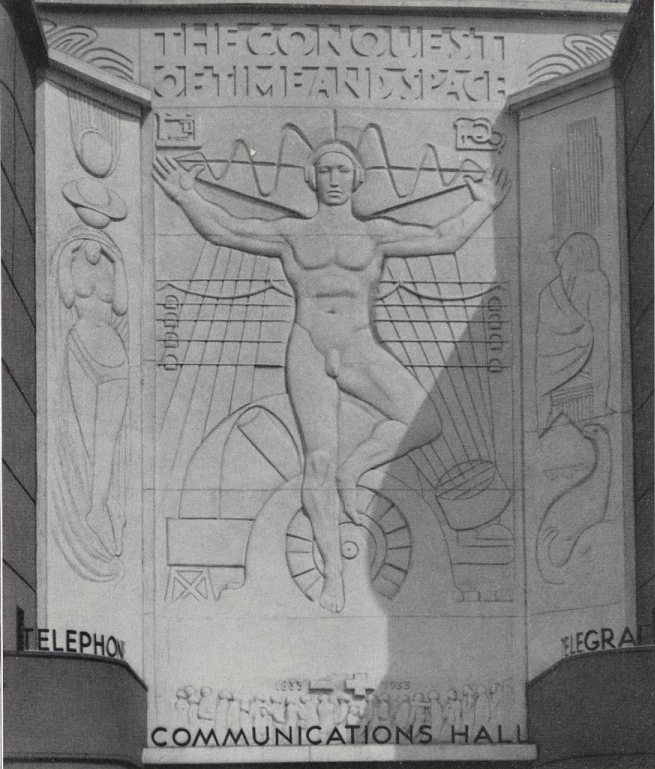
Inside the Hall of Electricity, a 90-foot-long diorama—rumored to be the world’s largest—depicted the “thrilling” story of power generation, transmission, and distribution. Upon leaving the hall, a visitor would come face-to-face with an even grander artwork. A massive bas-relief depicted the figure of “Human Genius” rising above a dynamo, with a radio, telegraph, telephone, and powerful electric lights at his disposal. Its sculptor, Gaston Lachaise, gave it an appropriately grand title: “The Conquest of Time and Space.”
The progress on display in Chicago, grandly fêted as it was, was nevertheless very real.
“The Backbone of Everyday Life”
By 1933, electricity had cemented its role as the central driver of American commerce and society. Manufacturing and industrial concerns used 52 billion kilowatt-hours of power that year, and electricity was increasingly used in the home as well. By 1930, residential service had reached nearly 85% of all non-farm residences in the U.S.
At home, consumers welcomed this development with open arms—and their wallets. Residents expanded their electric use beyond indoor lighting, to include electric irons, radios, waffle makers, and toasters. The grid had come to function as “the backbone of everyday life,” and given humanity’s “conquest” of nature, its users expected that the power would always be on.
That conquest would prove to be less absolute than believed.
“No More Big Blackouts”
The term black-out, or blackout, entered the American lexicon around this time. Initially denoting a darkened theater stage, or a loss of vision or memory, blackout was used to describe a failure of an electricity system as early as 1934.
For years, however, newspaper reports of power outages mostly applied blackout as a verb (or, at least, those from the New York Times mostly did so). A hotel in Atlantic City was “blacked out” by a transformer fire (1949); a short-circuit in a Consolidated Edison substation “blacked out” 9,463 homes in Westchester (1954); several counties in Ohio were “blacked out” for nearly an hour due to a power failure (1960).
A blackout morphed into a noun due to, in part, two major outages that struck New York City soon thereafter. The sheer size of the interruptions seemed to elevate them to event status.
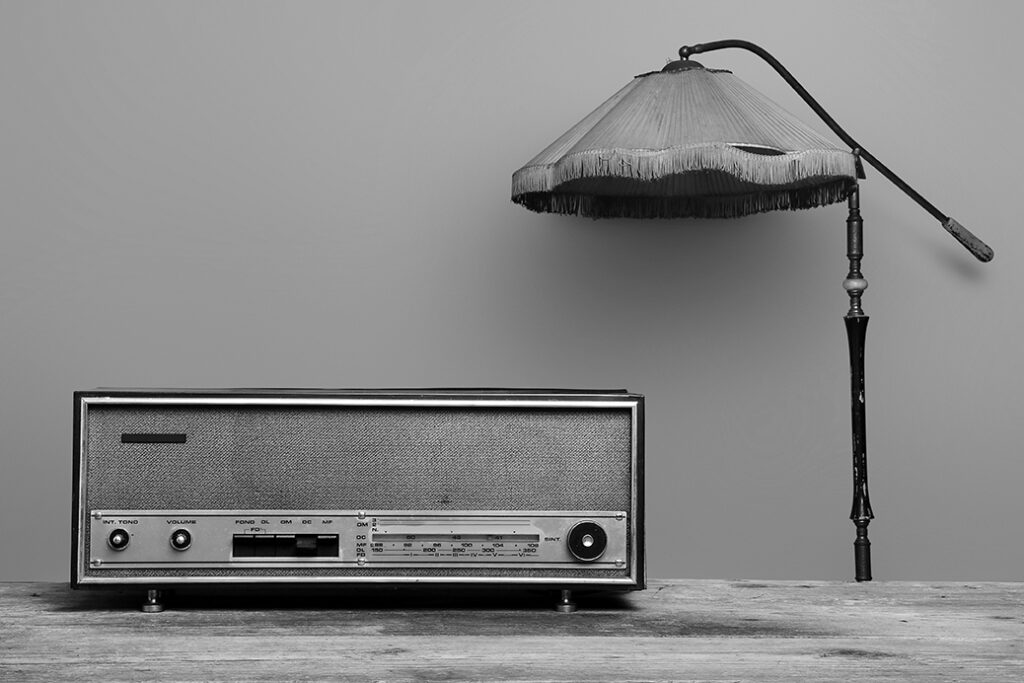
The “blackout” of 1959 saw overloaded cables cut power to 500 square blocks and 500,000 people in upper Manhattan, leaving them “without lights, refrigeration, air conditioning, television, and radio.” Two years later, the “blackout” of June 1961 darkened five square miles of Midtown, after equipment failures at a substation led to a “massive” power failure.
The editorial page of the New York Times took notice. “It would be unreasonable,” the editors wrote a month later, “to expect a total absence of interruption in the delivery of electric power in a city of New York’s size and vast demand.” But—investments in electric system “contingencies” were needed to prevent future large-scale outages.
“No More Big Blackouts,” the editorial pleaded.
“No One Expected a Crippling Blackout”
The “Big” one came just a few years later.
In the early evening of Tuesday, November 9, 1965, on a high-voltage transmission line running from Niagara Falls, NY, into Canada, a protective relay switch “tripped” off without warning. Suddenly, 1,500 megawatts (MW) were redirected southward, triggering a cascade of equipment failures, power swings, and automatic disconnects.
In less than 3 seconds, the surge disabled the region’s remaining transmission lines, and plunged the “City that Never Sleeps” into a forced repose.
The Great Blackout of
1965
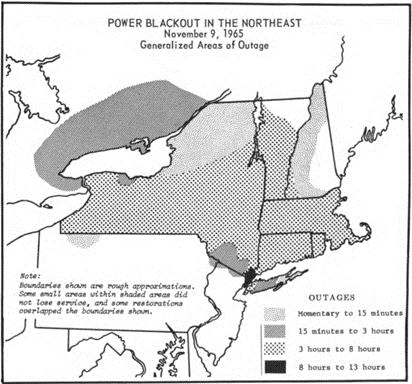
The effects of the Great Blackout of 1965 were massive in scale: it knocked out 20,000 MW of demand, and some 30,000,000 people were witness to darkened building lights, inoperable traffic signals, and stalled railroad cars for upwards of 13 hours. The outage covered 80,000 square miles of New England, New York State, and parts of Ontario, Canada—enough space to fit the borough of Manhattan inside more than 3,500 times.
The blackout’s severity caused concern at the highest levels of government, even thousands of miles away. While at his ranch in the Texas hill country, President Lyndon Johnson first learned of the blackout from a radio broadcast. The first call that he placed was to the Secretary of Defense, to confirm that the nation’s missile defense systems remained powered and “alert.”
To most, the 1965 event came as a surprise. As historian Julie A. Cohn has written, “most power system experts had not contemplated a cascading breakdown of such enormity” prior to 1965. While small-scale outages were understood to be all but inevitable, the bulk power system had proven very reliable through the 1960s, enough so that “no one expected a crippling blackout” would occur.
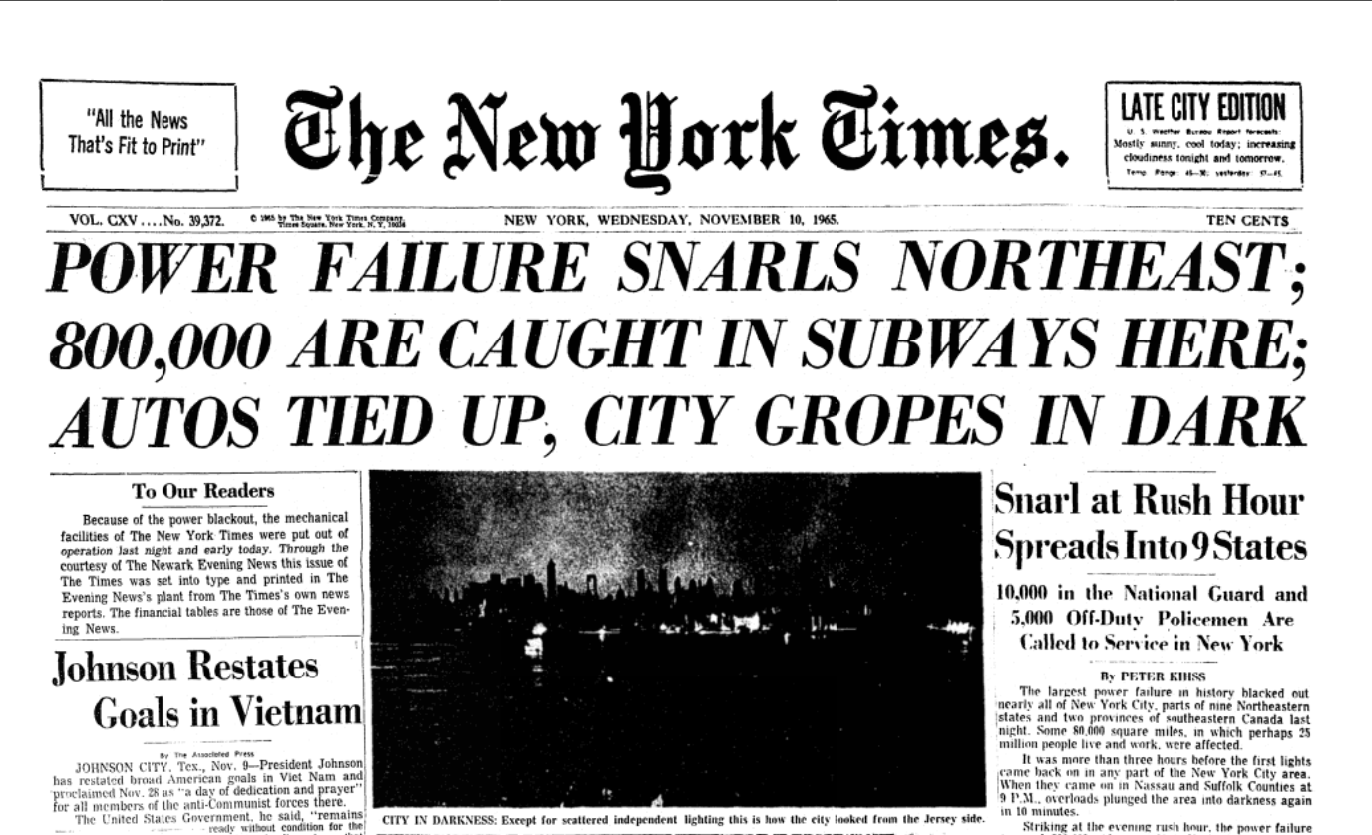
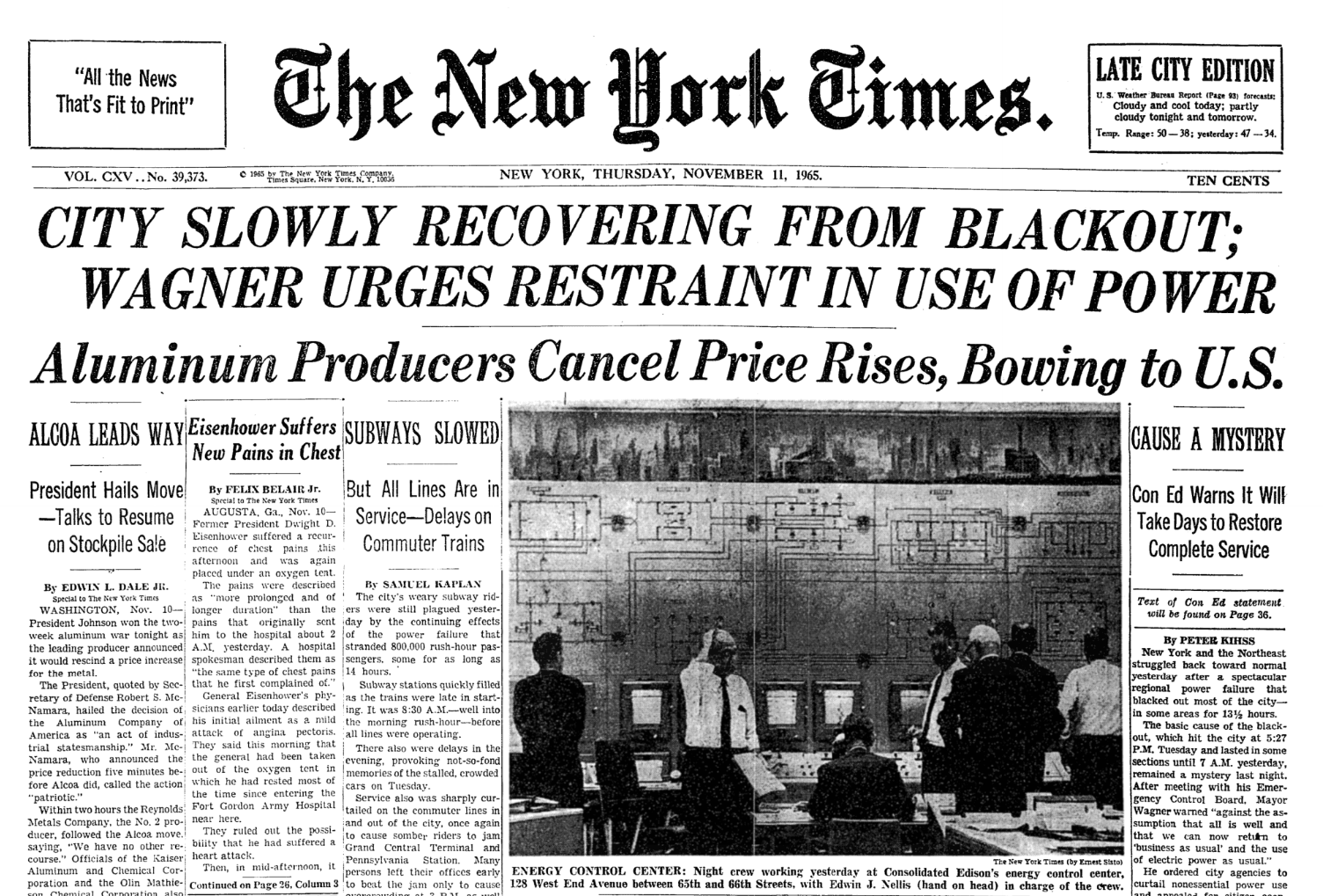
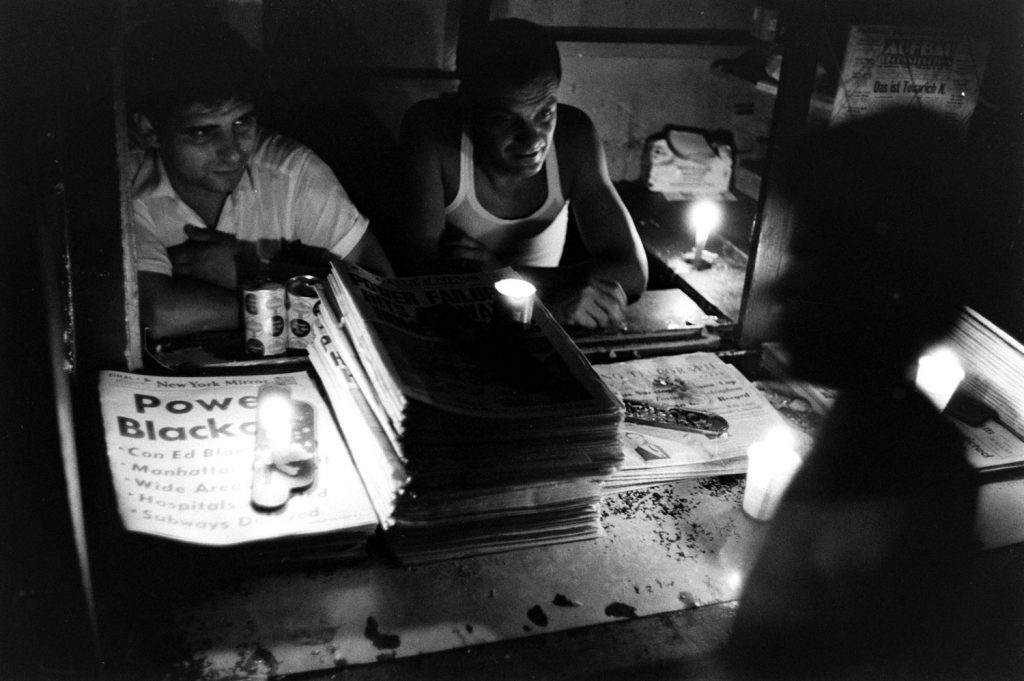
Even the newspapers were caught a bit off guard. The day after the 1965 outage, the New York Times’ banner dubbed it a “POWER FAILURE.” On the day after that, “BLACKOUT” had taken its place in bold type across the front page.
“An Interesting Lesson”
Each blackout in New York City comes with its own lore, and the 1965 event took on a patina of novelty and innocence. New Yorkers seemed to take the event in stride, interpreting the outage at first as but an “ordinary interruption of service,” and many reveled in the unexpected pause from the busyness of everyday life.
For the electric power industry, the blackout of 1965 would prove to be a seminal event. Its aftermath established an important precedent: major power failures in the U.S. spawn investigative commissions, technical studies, and industry-led initiatives to improve system reliability. In the decades since, more than a dozen major blackouts have hit the grid, although none as large as the 1965 outage.
That was, until a late summer afternoon on August 14, 2003, saw the single largest blackout event in North America.
2003
While many feared it a terrorist attack, the blackout’s cause was far more mundane: a series of treefalls onto lines, equipment failures, inaccurate computer data inputs, and inadequate visibility into the grid’s real-time operations compounded into a cascading failure.
Its effects were catastrophic all the same. An estimated 50 million people lost power, many for days on end. Cell phone service was spotty, many flights were grounded, and other key infrastructure systems went offline. The outage seemed to echo prior blackouts in the region,” and this time, the paper of record wasted no time in dubbing it the “Blackout of 2003.”
Even so, the fullness and rapidity of the grid’s cascading collapse suggested that the blackout of 2003 was unlike its predecessors in a meaningful way.
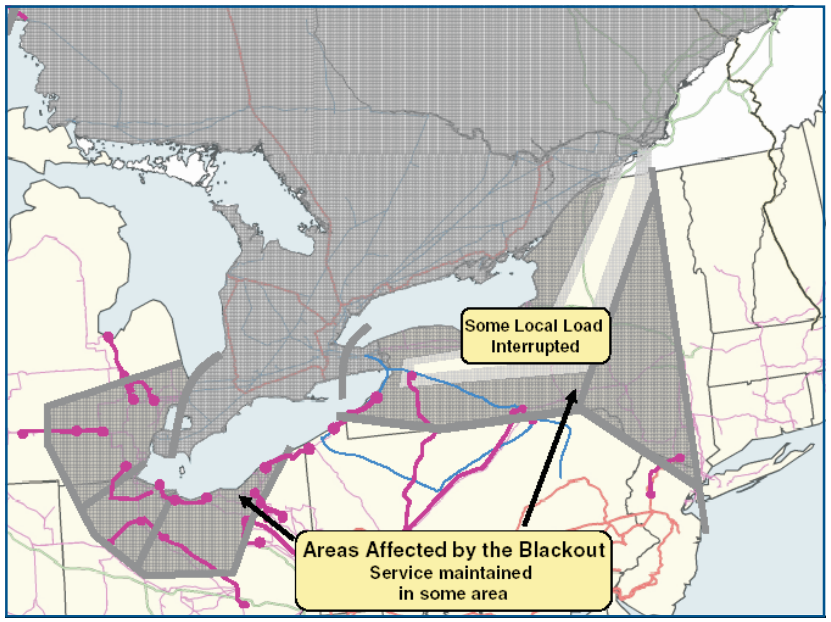
The grid had expanded its electric service dramatically since the 1960s, added new sources of generation, and equipped itself with digital technologies to enable rapid command-and-control of interrelated components. And yet—key portions of the same grid had also grown long in the tooth, with power lines and equipment operated well beyond their design life.
As President George W. Bush said to reporters that evening, investigators would determine “why the cascade was so significant,” and how “it was able to ripple” so rapidly across the region. Moreover, the president said, in due time leaders would need to review whether grid modernizations or new practices could prevent similar blackouts. “This is going to be an interesting lesson for our country,” Mr. Bush concluded, “and we’ll have to respond to it.”
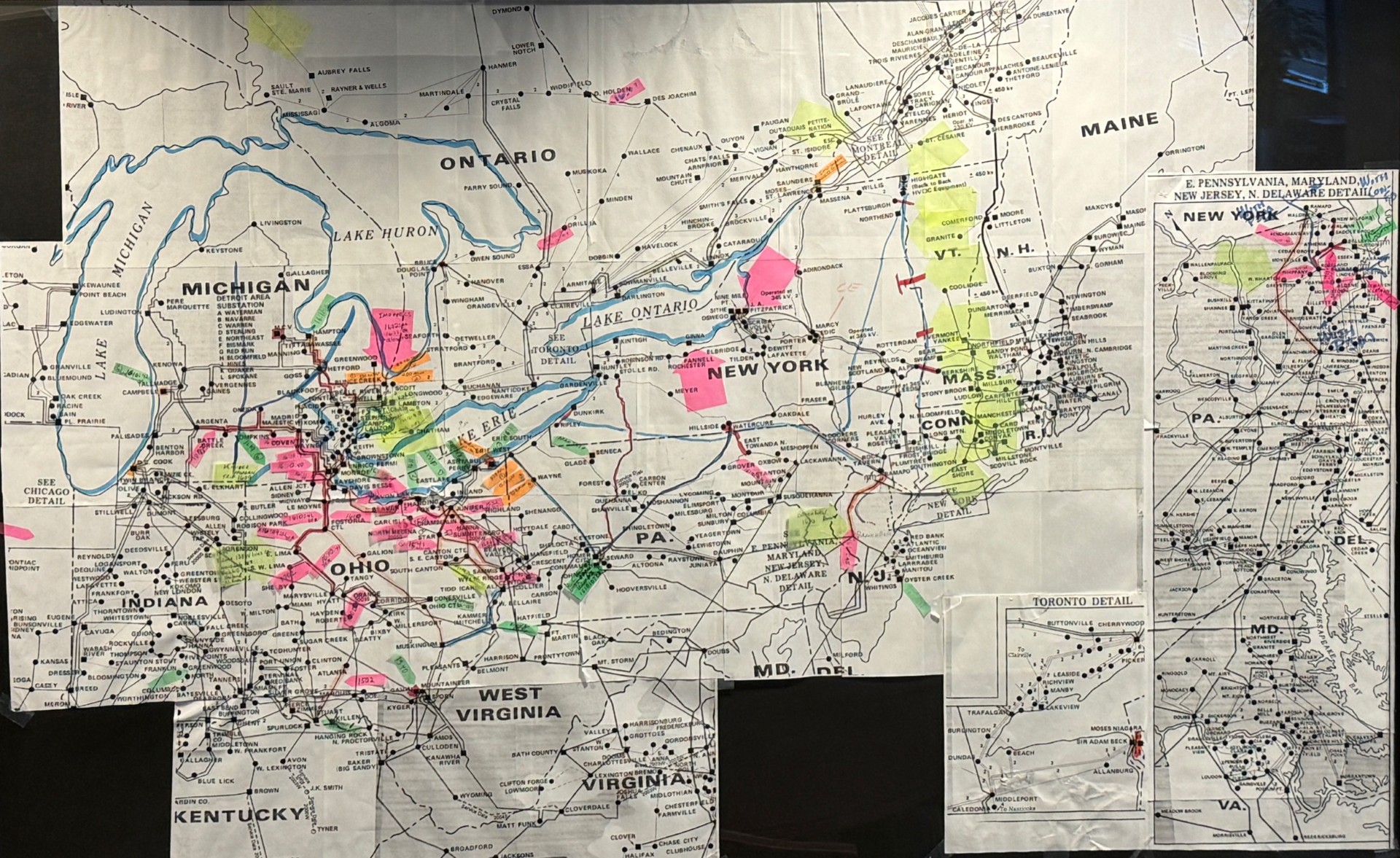
This transmission line map of the area affected by the 2003 blackout was used by NERC staff to document the initial information gathered from the industry on the timing and sequence of events that occurred on the afternoon of August 14, 2003. Working through the night, the staff was able by the next morning to identify essentially WHAT had occurred prior to and during the cascading portion of the event. It took many months, however, and many volunteers from the electric industry and the governments of the U.S. and Canada, to confirm WHY the event occurred and what is needed to prevent a recurrence.
Source: This photo of the actual map was provided courtesy of the North American Electric Reliability Corporation (NERC). The map resides today in the NERC offices in Atlanta, Georgia.
Explore the History – Major U.S. Blackouts and their Causes, Effects, and Lessons-Learned
As the grid undergoes its transformation away from thermo-mechanical generation sources to one dependent on power electronics and renewable generation, it is instructive to review past blackouts—as they are the essential examples of unreliability. At times, lessons-learned from one blackout has helped to prevent future outages, or to limit their severity. At other times, policy leaders and electric operators have focused too closely on mitigating the cause of a particular blackout, losing sight of other vulnerabilities in the grid.